
HF Propagation
Hi, I’m André
I’m a Brazilian software engineer and a licensed amateur radio operator in both Brazil and Canada.
I’m passionate about experimenting with new technologies, especially coding, artificial intelligence, electronics, and radio communication.
To my amateur radio friends: I record some of my contacts and post them on YouTube. If you had a QSO with me, you can find it in my videos by clicking the button below.
Look for your callsign in my videos
Ham Radio FAQ
Amateur radio, also called Ham Radio, is a service available to properly licensed individuals. Most users engage in it as a hobby, which involves talking to people all over the planet via voice, Morse code, or digital modes. Technical experimentation and improvement are also important aspects of the hobby.
Of course! First, I want to explain that there are many different facets to the hobby. For example, there are operators who like to talk locally, use modes that allow linking with the internet to deliver their voices to other places on the planet, digital modes, satellites, lunar reflection, and so on.... The one I enjoy the most is making long-distance contacts, which we call “DX”.
Different frequency ranges behave in different behaviors. For DX, the most important factor is how radio waves propagate through the Earth’s atmosphere. See the image below — we mostly use the low-frequency bands for this.
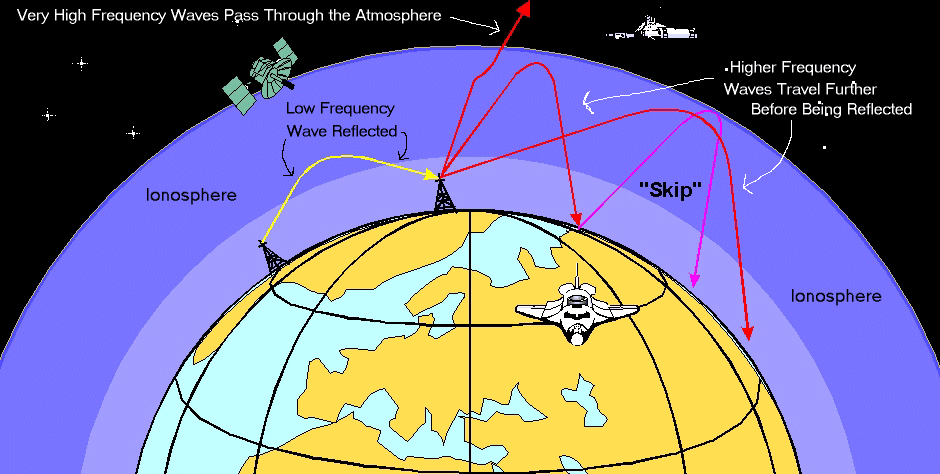
In the image, you can see that the radio waves "bounce" off the ionosphere and return to Earth. This allows us to communicate with people who are far away. The higher the frequency, the more difficult it is for the radio waves to "bounce" back to Earth. Also, the higher the frequency the smaller the antenna and better signal quality. That's why I use a big antenna, and you can notice that the audio is a bit weird and distorted.
Basically in ham radio we communicate via voice, morse code, or digital modes. On voice and on morse code the contacts can be a short exchange of signal strength or a long conversation. On digital modes the contacts are made of short exchanges like signal strength, location, etc. On all modes we exchange our callsigns and if you don't have one, no one will reply to your call since amateur radio is also a self-regulated service. In this page you will find more details on what is a callsign and how to get it.
Voice is the most common mode since it has the least friction. Here's an example of a voice contact.
Morse Code, which is the one I like the most, is the least common mode since it involves learning Morse Code. If you want to understand the proper way to learn Morse Code, I also made an App for that! See below an example of a Morse Code contact.
Digital Modes are the most common mode for people who like to experiment with technology. It involves using a computer to decode the signals. Below is an example of a digital contact.
And that's it. As I said before, this hobby has many facets and this is the introduction to only one of them!
You need to obtain a license by passing an exam and then purchase the necessary equipment.
The exam is fairly simple, and its goal is to help you understand the basics you'll need to get started in the hobby. In Canada, you can use the HamStudy series, or even try an app I made myself that includes the possible test questions.
For the exam, you can take it online. I recommend taking it with Vince
A callsign is a unique identifier of a properly licensed individual. To get an Amateur Radio callsign you have to pass a test. This test is not hard and its goal is to make sure you are completely capable of operating your equipment and making sure that you understand the ethical aspects of operating an Amateur Radio station.
Depending on the radio waves propagation conditions, you can be heard on the entire planet ... so avoiding talking about religion and politics is a good example of ethics in Amateur Radio.
A callsign has the information of your location plus a few letters you can choose. Example: VE2ZDX means:
- VE: Canada
- 2: Quebec
- ZDX: The letters I chose.
In Brazil, the callsign is a bit different. The first letter is the country, the second letter is the state, and the last letters are the ones you choose. Example: PY2KGB means:
- PY: Brazil
- 2: São Paulo
- KGB: The letters I chose.
A country can have more than one "code". Canada can be VE, VA, VO, etc. Brazil can be PU, PP, PR, PY, etc.
When we do a contact we can go to some websites where Amateur Radio Operators themselves register their information. The most famous one is QRZ.com. Check it out and type one of the examples above in the search.
Basic equipment includes a transceiver, an antenna, and a power supply. Below, I'm listing a configuration that is very common in North America due to its portability and flexibility.
- Yaesu FT-891
- Vertical Antenna. This you don't actually need because you can easily make your own antenna.
- Power Supply. This is also just a suggestion, commonly used with this radio.
Buying second hand gear is also a good option. Normally, amateur radio operators take good care of their gear.
Selling might be an issue if you're not licensed. It's common for people to ask for your callsign when buying or selling, to understand how the gear was used or how it will be used.
You can hear the amateur radio frequencies online via Web SDR. This link (or just look for "Kiwi SDR" on Google) will take you to a list of Web SDRs of the Kiwi platform. Pick one of the stations in the map to listen to. You will see a waterfall display, you just need to click where you see a station. You will understand when you see it.
Here are some I like to use:
There are many frequencies you can listen to, the most populated ones are:
- 21 Mhz: start your search at 21200.00 mode USB. This frequency is more populated during the start of the day.
- 14 Mhz: start your search at 14200.00 mode USB. This frequency is more populated during the afternoon.
- 7 Mhz: start your search at 7150.00 mode LSB. This frequency is more populated during the evening.
- 3 Mhz: start your search at 3900.00 mode LSB. This frequency is more populated later at night.